
This entry documents the technical and photographic factors that determine what an Insta profile picture viewer actually shows, paired with short illustrative cases that make the more abstract points concrete rather than purely theoretical. Each case below is meant to stand on its own as a self-contained example, so the entry can be read straight through or referenced piecemeal for whichever factor is currently relevant, depending on what actually brought you here in the first place.
Overview
An Insta profile picture viewer displays a profile photo at a size larger than Instagram’s default circular thumbnail. What that larger view actually reveals depends on a handful of documented factors covered below, not on the specific tool used to retrieve it. Understanding those factors turns an inconsistent, occasionally confusing experience into something predictable and well understood.
Key Terminology
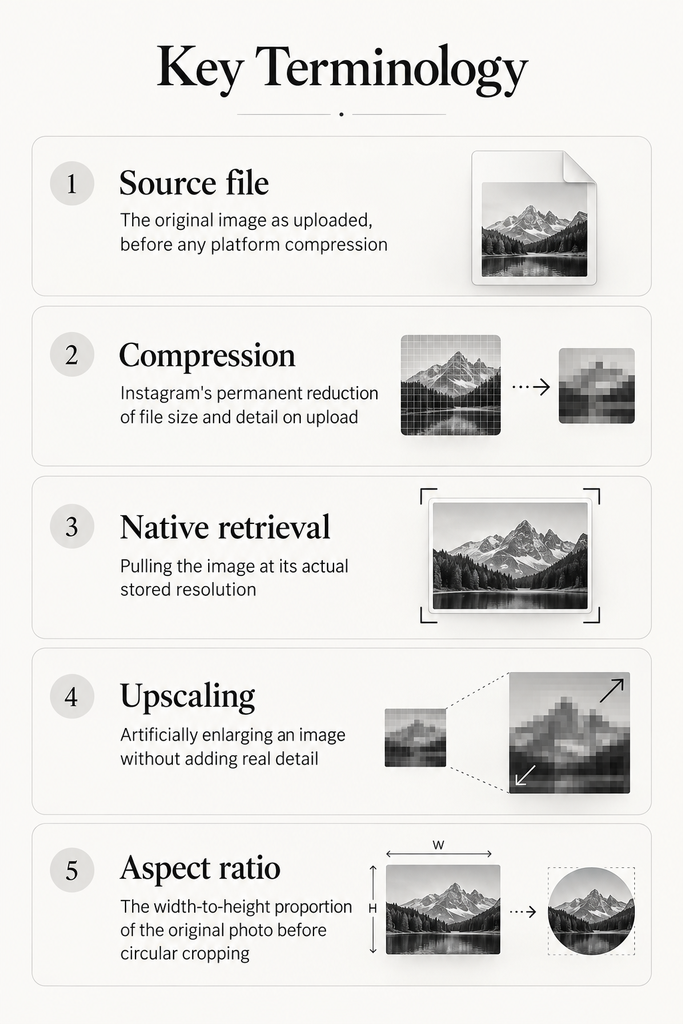
| Term | Definition |
| Source file | The original image as uploaded, before any platform compression |
| Compression | Instagram’s permanent reduction of file size and detail on upload |
| Native retrieval | Pulling the image at its actual stored resolution |
| Upscaling | Artificially enlarging an image without adding real detail |
| Aspect ratio | The width-to-height proportion of the original photo before circular cropping |
Case Note: The Business Logo Problem
A small business owner wanted to check whether a competitor’s logo, used as their profile picture, was original artwork or a stock template. Nothing scandalous, just the kind of small competitive curiosity that comes up constantly in retail. Viewed as Instagram’s default circle, the logo was too small and cropped to tell anything meaningful from it. Pulled through an Insta profile picture viewer at full size, the uncropped square revealed a watermark in one corner that the circular crop had been hiding the entire time. The larger view didn’t change the image. It just stopped hiding information that was already there, sitting in the file the whole time, waiting for someone to actually look at the full frame instead of the tiny circle everyone defaults to.
Documented Quality Factors
Original resolution. The single largest determinant of result quality. A photo uploaded at high resolution retains far more usable detail once enlarged than one uploaded small, regardless of retrieval method. This factor alone accounts for most of the variation documented across different accounts.
Compression artifacts. Instagram’s compression can introduce visible blocking or softness, particularly in areas of fine detail or subtle color gradients. This is a permanent property of the stored file, not something any Insta profile picture viewer method reverses once it’s been applied on upload.
Cropping loss. The circular thumbnail permanently hides the corners of a square upload in day-to-day display, though the underlying file retains that data. Full-frame retrieval restores visibility of that cropped content without altering the file itself, simply presenting more of what was already stored.
Device capture quality. Photos taken on older or lower-end cameras generally contain less recoverable detail at the source, independent of how they’re later viewed or retrieved. This factor predates the platform entirely and has nothing to do with Instagram’s own processing.
Case Note: The Ten-Year-Old Photo
A user comparing two versions of the same friend’s profile picture over several years noticed something odd: the earliest uploaded photo, from roughly a decade back, looked noticeably softer than a photo the same friend uploaded last year, even though both were viewed through the identical Insta profile picture viewer method. At first it seemed like the tool must be inconsistent. It wasn’t. Nothing about the retrieval had changed between the two lookups. What changed was the source: an older phone camera with a lower native resolution, uploaded during a period when Instagram’s own processing pipeline handled images somewhat differently than it does now. The comparison illustrated the resolution factor more clearly than any written explanation could, since the two photos sat side by side with only one variable actually different between them, and the difference was obvious the second they were placed next to each other.
Common Issues Reference
| Symptom | Likely Cause |
| Pixelated or blocky result | Upscaling a small source file rather than native retrieval |
| Soft but not blocky result | Compression artifacts on an otherwise reasonably sized source |
| No image loads | Account visibility restricted to approved followers |
| Unexpectedly sharp result | High-resolution original successfully retrieved at native size |
Case Note: The Restoration Project Comparison
A photography student working on a personal project about digital image degradation used several profile pictures, viewed at full size through an Insta profile picture viewer, as reference material for a piece about compression artifacts. It started almost by accident, a side note in a bigger project, before it became the most interesting part of the whole thing. Comparing the retrieved images against the same photographers’ full-resolution portfolio uploads elsewhere made the platform’s compression pattern visible in a way that was hard to see in any single image alone. Viewed side by side, the pattern became obvious, a consistent softening in shadow detail that showed up across every compressed image regardless of subject matter. Viewed one at a time, it had simply looked like ordinary softness, easy to mistake for a camera limitation rather than a platform-level processing choice, which is exactly the kind of thing a knowledge base entry like this one exists to clear up.
Related Concepts
Digital compression is the broader category of technique this entry’s compression factor belongs to, used across nearly every image-hosting platform in some form, not something unique to Instagram specifically.
Aspect ratio and cropping is a foundational photography concept that explains why the circular crop specifically affects certain compositions more than others, particularly ones relying on elements near the edge of the frame.
Resolution ceiling is the practical limit on displayable detail once a source file has been compressed or captured at a fixed pixel count, a concept that applies well beyond profile pictures to nearly any digital image.
Why This Matters Beyond Curiosity
Understanding these factors has practical value beyond satisfying idle curiosity about a specific photo. Photographers evaluating their own profile picture choices benefit from knowing whether a soft result reflects a genuine composition or upload problem versus an unavoidable compression limit, rather than assuming their equipment or technique is somehow at fault. Researchers and archivists working with platform-sourced imagery need to distinguish artifacts introduced by the platform from properties of the original photograph, a distinction that matters a great deal in any serious analysis of digital media over time. And anyone troubleshooting a disappointing lookup benefits from knowing when to stop trying additional tools, since the underlying source file, not the retrieval method, is usually the actual limiting factor, no matter how many different sites get tried in search of a better result.
The case notes above were chosen specifically because each one illustrates a different documented factor in isolation. The logo case demonstrates cropping loss. The decade-old photo case demonstrates resolution and capture quality. The restoration project case demonstrates compression artifacts becoming visible only through direct comparison. Together, they cover the practical range of what this entry documents more thoroughly than the factor list alone.
A Note on Scope
This entry covers image quality and photographic factors specifically. It does not cover, and doesn’t claim any relationship to, access to accounts that have restricted their visibility. Every case and factor documented here applies exclusively to profile pictures on accounts already visible to the public, consistent with how Instagram’s own visibility settings function regardless of which Insta profile picture viewer method is used to retrieve a larger view.
Editorial Note
The case notes throughout this entry are composite illustrations built from common, recurring scenarios rather than documentation of specific individuals or accounts. They’re included because the underlying technical factors, resolution, compression, cropping, tend to click faster through a concrete example than through definitions alone. An Insta profile picture viewer is, in the end, just a different window onto the same stored file Instagram already has. What that window reveals depends entirely on what was there to begin with, a point worth returning to whenever a specific result seems inconsistent with expectations.